








Teaching English in Japan
Job description
- You will be employed as an Assistant English Teacher (ALT) at schools. Your school can be a primary school (age 6 to 12), junior high school (age 12 to 15) or high school (age 15 to 18).
- As an ALT, you will be assisting an English teacher (who is Japanese) in English classes. You will liaise with the teacher and the school on a daily basis.
- Your tasks include preparing materials to interact with students, and delivering lessons.
- You are not required and are not expected to speak or use any Japanese in lessons. But outside classrooms, for example with your Japanese colleagues, it is always good to try speaking some Japanese as they will appreciate your effort. And that’s the best way to learn the language and the culture!
- Remember that in Japan it is very rare, especially amongst young Japanese, to encounter an English speaking foreigner. You will be the students’ gateway to a culture and value system that they are not accustomed to. Enjoy educating the students and spreading the knowledge you have!
- A classroom usually contains 30 to 40 students.
- Your working hours can range from 5 hours a day to 9 hours a day, depending on your school. The average working hours are from 8:00 to 15:00, with breaks between classes.
- Most of the time you will be the only non-Japanese teacher at the school.
- Some employers allow you to take on private English lessons outside your work hours. This will be a good source of extra income. Students can be adults or university students who want to improve their level of English. These private lessons often take place in a less formal environment such as coffee shops or fast-food restaurants.
- If there is any issue, your school, your employer and the Teach Japan staff are always here to assist you.
Who will be my employer?
- You will be employed by one of our reputable clients: either a Japanese school or an agency in Japan that places teachers at schools. We regularly conduct meetings with our clients to assess their credibility and suitability. All our clients are reputable organisations that have decades of experience in the business.
- Your employer will be a reputable organisation that has been specifically selected by us in Japan.
- You will be directly put in contact with your potential employers during the recruitment process. Feel free to ask them any questions you may have.
Contract length and start time
- The Japanese academic year starts in April and ends in March, and most contracts follow this routine.
- A standard contract is 12 months and it can be renewed at the end.
- A small number of jobs open up all year around.
Holidays
- There are 15 public holidays in Japan, compared to 12 days in South Africa.
- You will also get to enjoy long school holidays which are about 65 days a year. The exact duration of summer (July/August), winter (December/January) and spring (March) holidays vary depending on your location.
Salary
- Assistant Language Teachers (ALTs) earn a basic salary of between R16,000 to R30,000 per month.
- It is common for Japanese companies to pay the salary at the end of the following month. For example, if you start working in April, your April salary is paid at the end of May, and your May salary is paid at the end of June. This also means that if you stop working in December, you will still receive your paycheque at the end of January.
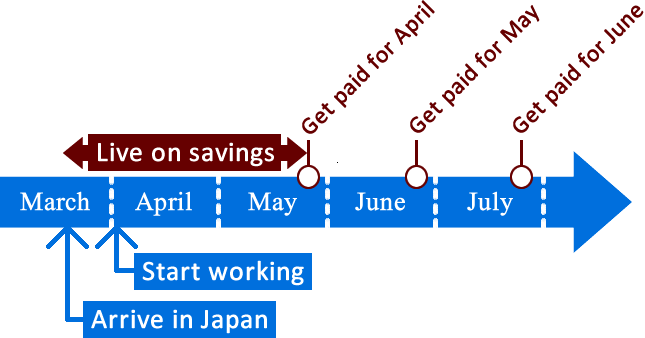
- In addition to your basic salary, many teach private English lessons outside their regular work hours. A good thing about these private lessons is that they can fetch between R100 to R400 per hour. So if you give weekly lessons to 5 students, and charge R250 per lesson, you will earn R5,000 a month in cash.
- Many teachers manage to save over R100,000 a year while working hard and living comfortably.
- During the holiday months many companies prorate the salary.
Allowances
- Employers will assist you finding a suitable accommodation and some even subsidise your accommodation expenses.
- Most employers reimburse your work related transport expenses.
Health Insurance
- While some companies and schools will provide a private social security package which includes health insurance, many will assist you to enroll in the Japanese universal health care system.
- Unlike in South Africa, the majority of the Japanese population enroll in the government’s national health care system by paying monthly premiums either to the employer or to the local municipality.
- Japan’s national health care system is a very economical and functional comprehensive insurance. It covers most medical expenses including prescriptions, emergency treatments, doctor visits, hospital cover and well as dental treatments. The health care covers at least 70% of expenses: you cover the remainder.
- You are allowed to choose any medical practitioners and hospitals and they all accept the national health care system. The standard of medical practice is high and there is no public-private division of medical standard like in South Africa.
- For your first year in Japan, the health insurance contribution will be about R300 per month. This contribution does not fluctuate according to the usage; rather the contribution calculation is based on your earning in the previous year.
Location
- Your employment location can vary from urban centres to rural areas. Some are even located on small islands! If you have any preference over location, please ask the potential employers directly at the interview.
Our service is FREE.
Apply now and let us find a job for you in Japan!
Check out general facts about Japan or living in Japan.
You can also read about the application requirements, what employers look for, the recruitment process or what we do for you.


