






Living in Japan

Japan is a very safe and convenient country to live in. Feel safe walking on streets anytime of the day and enjoy the convenience of 24-hour convenience stores and cooldrink vending machines found everywhere.

Money

  • If you are visiting Japan as a South African tourist, you will find Japan an expensive country. But you are not a tourist - you will be working in Japan and earning Yen! Living expenses are always relative to your salary, and you will find many things in Japan affordable in comparison to South Africa.
  • The Japanese currency is Yen: about 10 Yen to 1 Rand.
  • English teachers at schools (Assistant Language Teachers) earn a basic salary of between R16,000 and R30,000 per month.
  • In addition to the teaching job, many teach private English lessons outside their regular work hours. One good thing about these private lessons is that they can fetch between R100 to R400 per hour. So if you give weekly lessons to 5 students, and charge R250 per lesson, you will earn R5,000 a month in cash.
  • It is common for Japanese companies to pay the salary at the end of the following month. For example, if you start working in April, your April salary is paid at the end of May, and your May salary is paid at the end of June. This also means that if you stop working in December, you will still receive your paycheque at the end of January.
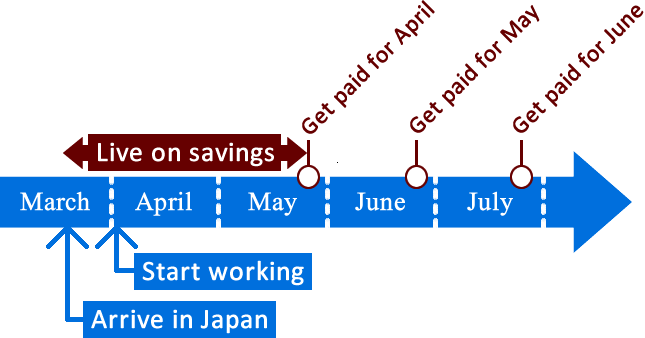
Salary timeline

  • Many teachers manage to save over R100,000 a year while working hard and living comfortably.
  • Your salary will be paid into your Japanese bank account. Your employer will assist you in opening this bank account.
  • A can of Coke costs R13, a 1 litre of milk costs R18, a McDonald's meal costs R70, a decent meal at restaurant costs R100, a Nike T-shirt costs R100, a pair of Nike shoes costs R600, monthly rental for a 1 bedroom apartment ranges from R4,000 to R10,000.
  • South African issued credit cards (eg. Visa and Master) and debit cards (eg. Visa debit) can be used at most shops and supermarkets. Ask your bank for the fee structure.
  • South African bank cards can also be used at ATMs to withdraw Japanese Yen. Ask your bank for the fee structure.
  • The best way to convert your Rand to Yen is to use your South African credit cards/debit cards in Japan to swipe or to withdraw cash at ATMs. Bringing Travellers Cheques or exchanging cash will cost more.
  • Do not forget to inform your South African bank that you are travelling to Japan. This will prevent your bank blocking your account.

Safety

  • Japan is one of the safest countries in the world. The crime rate is lower than all other developed countries.
  • Guns are banned to the public. Police officers carry a gun.
  • In 2008 the gun related homicide rate was 0%.
  • All swords must be registered and they are quite rare.
  • The murder rate (rate per 100,000 population per year) in Japan is 0.3% and this is ranked the 4th safest in the world. South Africa's murder rate is 31%, the 195th in the world.
  • The robberies rate (rate per 100,000 population per year) in Japan is 0.004%, ranked the 10th safest in the world. South Africa is 0.5%, ranked the 102th in the world.
  • If you drop a cellphone in the street or leave behind a hand bag at a restaurant, you will most likely get it back.

People & Language

  • In 2012, the world's largest travel website, TripAdvisor, ranked Tokyo as 2nd in the world in the friendliest locals category.
  • In the same survey, Tokyo was ranked 1st in the world for the cleanest streets category.
  • Although English is generally taught at schools (from age of 13), most Japanese cannot speak English. This is because the English education in Japanese schools is geared towards helping the students to pass the written university entrance exams, and it is not focused on practical communication. Also, many Japanese people have the fear of making mistakes in public (Japanese are often shy and also their culture puts emphasis on maintaining a good appearance/reputation) so they opt not to speak in English.
  • English signs are often found in public areas (train stations, street signs, restaurant menus).
  • Although the language barrier exists, generally people are willing to help if you need assistance.
  • No matter what your Japanese ability is, you will be just fine.

Transport

  • A lot of Japanese do not own a car as the public transport system is vast, fast, punctual, safe and affordable. From the bullet trains that run at 300 km/h to local subways, buses and taxis, all the means of transport are safe to use.
  • In 2012, the world's largest travel website, TripAdvisor, ranked Tokyo as 1st in the world for the friendliest taxi drivers, the best taxi service and the best public transport.
  • Cycling is a popular way to get around. You will find bicycles parked on the streets outside houses, shops, train stations, schools etc.
  • Cars drive on the left-hand side, just like in South Africa. If you need/want to drive, it is advisable to get an international drivers licence in South Africa.

Food & Drinks

  • Sushi is only one tiny part of the vast Japanese cuisine.
  • In Japan you will find different variations of Japanese cuisine as well as French, Italian, Chinese, Korean, Thai, Indian and the general Western cuisines.
  • Japan is the country with the most three-star (highest rating) Michelin restaurants. France comes 2nd.
  • Japan consumes about 10% of the global fish catch.
  • Meals are eaten with chopsticks, forks, knives and spoons, depending on what suits the meal best.
  • Fast food is popular too. There are McDonald's, Lotterias, Burger Kings, Fast Kitchens, and KFCs to name a few.
  • Per capita beer consumption in Japan is 44 litres per annum, compared to 61 litres in South Africa.
  • Apart from beer, popular alcoholic drinks are sake, shochu and mixers.
  • At many bars and restaurants you can take advantage of the “all-you-can-drink” deals, usually priced between R150 and R300 for 2 hours.

Medical care

  • Unlike in South Africa, the majority of the Japanese population enroll in the government’s national health care system by paying monthly premiums either to the employer or to the local municipality.
  • Japan’s national health care system is a very economical and functional comprehensive insurance. It covers most medical expenses including prescriptions, emergency treatments, doctor visits, hospital cover as well as dental treatments. The health care covers at least 70% of expenses: you cover the remainder.
  • You are allowed to choose any medical practitioners and hospitals and they all accept the national health care system. The standard of medical practice is high and there is no public-private division over medical standard like in South Africa.

Popular activities

  • Shopping. If you are into fashion, Japan will open new doors for discoveries. Japan is world-renowned for its fashion and you will see styles that are never seen in South Africa. You will find sales everywhere and the second hand clothing (amazing quality and variety and extremely low prices) market is huge.
  • If you are into electronics, get your hands on the latest gadgets before the world sees them.
  • You can still find the old Japan at the shrines and temples. Take a short trip to the countryside and taste the local cuisines and experience the onsen (hot springs). Kyoto is internationally famous for preserving ancient Japan but tourist locations are scattered everywhere in the country.
  • Over 70% of Japan is mountainous forest. There are plenty of areas to explore for nature lovers.
  • Skiing and snowboarding in winter in Hokkaido is a must. The island gets one of the best quality snow in the world.
  • Head south for diving in Okinawa where 200 of the world's 800 species of coral inhabit the warm blue ocean.
  • Theme parks are very popular in Japan. There is a Disney Land in Tokyo, a Universal Studio in Osaka, and a Fujikyu Highland that hosts one of the fastest roller coasters in the world.

Nightlife

  • Izakayas - a type of Japanese drinking establishment that serves food and drinks - are found everywhere. In izakayas you can take advantage of all-you-can-drink specials as well as enjoy many of Japanese snacks and meals.
  • There are plenty of western-style bars in Japan. Many of them have their entrance facing the street so they are easy to find, while others, which tend to be smaller in size, are located inside buildings.
  • You will find sports bars with TV screens showing live sports as well as Irish pubs serving European beers.
  • In cities, there are clubs where you can dance the night away.
  • Whether you are a good singer or not, you will definitely experience the famous Japanese entertainment, Karaoke. In Japan, karaoke usually happens in a private room with your friends or colleagues, with a waiter serving drinks. Most of the karaoke establishments are open 24/7.
  • Your typical Friday evening may start at a restaurant enjoying the "all-you-can-drink" special. Then you walk through neon lit streets to pubs and clubs. At 2AM, when your legs are tired, hit a nearby Karaoke joint. When your voice is gone, stroll into a ramen noodles restaurant or a 24-hour convenient store for breakfast.

Phones & Internet

  • South African smartphones can be used in Japan. Insert a Japanese SIM card in your phone and you will be able to send SMSes/WhatsApps/emails to your family and friends back in South Africa just like you are in South Africa.
  • Use your laptop/smartphone/tablet to use voice/video chat (eg. Skype) with family and friends in South Africa for free.
  • Do not forget the 7 hour time difference (Japan is ahead).
  • About 90% of homes and 99% of businesses have internet connection.
  • Contracting an uncapped ADSL internet connection (5Mbps to 40Mbps) to your home costs about R200 per month.
  • Contracting an uncapped fibre optic internet connection (40Mbps to 80Mbps) to your home costs about R400 per month.
  • Internet is not censored, unlike in China.

Electricity standard

  • The voltage used throughout Japan is 100 volts.
  • Many modern electrical equipment such as laptops, smartphones and digital cameras have a capability to take in power of between 240 volts (South Africa) and 100 volts (Japan). You only have to change the plug point and no converter is required.

What should I bring to Japan from South Africa?

  • Open mindedness.
  • Your South African issued bank cards/debit cards/credit cards to access your savings.
  • Savings. You will need to live on your savings until your first pay cheque arrives, which will only be at the end of the second month. It is common for Japanese companies to pay the salary at the end of the following month. For example, if you start working in April, your April salary is paid at the end of May, and your May salary is paid at the end of June. For this reason we strongly advise applicants to have at least R40,000 in their savings when arriving in Japan to cover the living expenses in the first two months.

Salary timeline

  • Smartphone/laptop/tablet so that you can keep in touch with your family and friends back in South Africa.
  • Clothes and shoes. The Japanese sizes are very often smaller than the South African sizes. For example, if you are a size M in South Africa, expect to buy size XL in Japan.
  • International drivers licence if you are planning to drive in Japan.
  • It is strongly advised to take out health insurance for the duration of your stay before you start your employment in Japan.

Our service is FREE.
Apply now and let us find a job for you in Japan!